Bald Hills
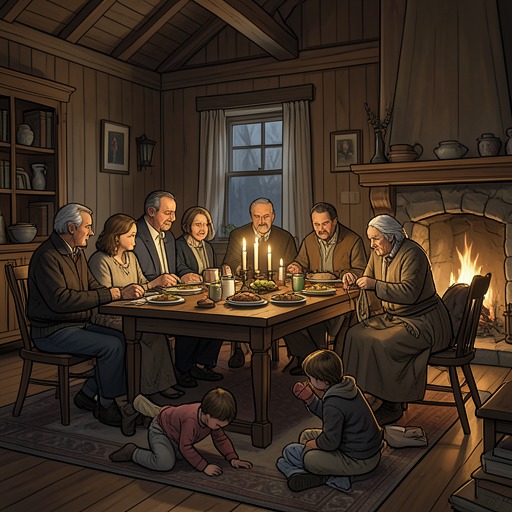
War and PeaceBald Hills is the Bolkonsky family estate and one of the novel’s most sharply defined domestic spaces. Forty miles east of Smolensk and two miles from the main road to Moscow, it is governed by Prince Nicholas Bolkonsky’s rigorous habits, intellectual principles, and refusal to surrender control. The estate’s apparent order does not isolate it from history: the arrival of Prince Andrei Bolkonsky and Princess Lise Bolkonskaya, the movements of Princess Marya Bolkonskaya, and the approach of the French invasion of Russia steadily turn the household into a place of expectation, conflict, and danger.
Estate and Household Order
Bald Hills is introduced as a place where an old prince’s personal routine has become the organizing principle of an entire household. Prince Nicholas Bolkonsky, known in society as the “King of Prussia,” has lived there continuously with his daughter, Princess Marya Bolkonskaya, and her companion, Mademoiselle Bourienne. Although the new reign has made a return to the capitals possible, he refuses to leave the country, declaring that anyone who wishes to see him may travel the hundred miles from Moscow to Bald Hills, since he himself needs neither people nor anything else. His governing maxim reduces human morality to two vices, idleness and superstition, and two virtues, activity and intelligence; the estate therefore functions as a practical extension of his mind.
The household’s order appears in small, repeated regulations as much as in large decisions. When Yakov Alpatych departs on official business, the prince’s white beaver hat and walking stick accompany him as visible signs of household authority. Three well-fed roans stand harnessed to the conveyance, the larger bell is muffled, and the smaller bells are stuffed with paper because the prince permits no ringing bells at Bald Hills. The departure is attended by clerks, servants, domestic serfs, and members of the family, while cushions and bundles are arranged with an almost ceremonial precision. Such details make the estate’s discipline tangible: private preference has been converted into public routine.
Architecture, Distance, and Management
The estate’s physical setting combines remoteness with strategic exposure. Bald Hills lies outside the immediate urban world yet close enough to the road toward Moscow for military danger to reach it. Its distance from Smolensk places it within the geography of the campaign, while its position near the main road makes the household’s security dependent on information arriving from beyond the estate. The location is therefore neither a purely pastoral refuge nor an abstract family background; it is a rural residence placed directly in the path of national upheaval.
The contrast with Bogucharovo clarifies the kind of order associated with the Bolkonsky domain. When Pierre Bezukhov later visits Prince Andrei Bolkonsky at Bogucharovo, he finds a small, clean house, a newly dug pond, solid fences and gates, straight paths, strong bridges with handrails, two fire pumps, and a green water cart. The surrounding homestead includes a threshing floor, outhouses, stables, a bathhouse, a lodge, and a large brick house still under construction. Although this description concerns Bogucharovo, it extends the image of Bolkonsky estate management: rural space is measured, improved, and made legible through construction, maintenance, and regulation. Against Pierre’s newly inherited wealth and confused administration, the Bolkonsky environment appears as a model of deliberate management.
War Reaches the Estate
The approach of war first appears at Bald Hills as a problem of knowledge and preparation. Dessalles warns Princess Marya Bolkonskaya that the old prince is failing to take measures for his safety, even though Prince Andrei’s letter indicates that remaining at the estate may be dangerous. At his request, Dessalles drafts a letter for Princess Marya to the Provincial Governor at Smolensk, asking for information about the military situation and the danger facing Bald Hills. Yakov Alpatych is instructed to deliver the letter, learn what he can, and return quickly if the threat becomes serious.
The estate’s carefully controlled silence is also visible in Alpatych’s departure. The prince’s ban on ringing bells, designed as a household rule, acquires a new resonance when the family must move through a countryside threatened by military operations. Domestic discipline continues, but its adequacy is now tested by forces outside the prince’s authority. Bald Hills remains orderly precisely as the world around it becomes less predictable.
When the old prince finally reacts, he does so by transforming the estate into a defensive position. He orders the militiamen from the villages to be called up and armed, writes to the commander in chief, and announces that he will remain at Bald Hills to the last extremity. He leaves the decision about defending the estate to the commander in chief while stressing that one of Russia’s oldest generals would be captured or killed there. At the same time, he orders Princess Marya, Dessalles, and the little prince to depart for Bogucharovo and then Moscow. The estate thus becomes divided between resistance and evacuation: the old prince binds himself to the place, while the younger members of the household are directed away from it.
Family Conflict at the Threshold
Bald Hills is not merely the setting of the Bolkonskys’ political and military decisions; it is the enclosed space in which their most difficult emotional relations are exposed. Alarmed by her father’s feverish and sleepless activity after a period of apathy, Princess Marya refuses to leave him. For the first time in her life she disobeys him, and his anger erupts into a devastating accusation. He blames her for exhausting him, for causing his quarrel with his son, and for harboring suspicions intended to poison his existence; he drives her from his study and tells her not to let him see her.
The scene gives the estate’s order its human cost. The authority that maintains the household’s schedules, bells, servants, and defenses also produces a language of command capable of wounding the person closest to the prince. Yet Princess Marya interprets the limits of his violence with intimate knowledge: because he does not order her to be carried away by force, she understands that some part of him is relieved that she remains at home. Bald Hills therefore holds two contradictory meanings at once. It is a place where obedience is demanded, but also the place where familial attachment survives beneath words of rejection.
The next morning, the old prince puts on his full uniform and all his orders, prepares to visit the commander in chief, and goes into the garden to review the armed peasants and domestic serfs. The military display grows out of the estate’s domestic structure: the people who serve the household are now assembled as its defenders. Princess Marya listens from the window until frightened men rush up the avenue and the militiamen and servants begin to move toward the house, signaling that the crisis has passed from distant reports into the body of the estate itself.
Narrative Significance
Bald Hills is a rural chronotope of discipline, inheritance, and crisis. Its routines make ordinary life visible through concrete gestures—muffled bells, arranged cushions, regulated departures—while its geographical position exposes the limits of any private order. The estate’s meaning changes as the war advances: it begins as a self-contained world governed by an elderly prince, becomes a site from which information and warnings must be sought, and finally becomes a contested space of defense and evacuation.
Its importance also lies in the contrast between financial and moral forms of management elsewhere in the novel. Pierre Bezukhov inherits an income said to amount to five hundred thousand rubles a year but cannot understand where the money goes; his estates, debts, stewards, and attempted reforms reveal the fragility of wealth without practical control. The Rostov family’s life at Otradnoe likewise produces steadily increasing debts, while the family’s move to Saint Petersburg is shaped by the old count’s need to seek an official post. Against these unstable economies, Bald Hills represents an ideal of organized authority, though the estate’s order cannot prevent illness, family suffering, or invasion.
The place finally matters because history enters it without abolishing its intimate scale. Military danger is registered through a letter, a carriage, a review of peasants, a father’s command, and a daughter’s refusal to depart. Bald Hills makes national catastrophe legible as a disturbance in household routine, while the household’s habits reveal how power is lived by those who govern and those who obey.